- My Role
- Product owner & tester: the idea, the plan, the layout, every account and deployment step, and testing every version
- Built with
- Claude Code (AI-assisted coding). I directed the build and tested it; Claude wrote all of the code.
- Timeline & Status
- Brief to live site in about three days (Aug 3–6, 2026). Live and invite-only.
Overview
Counter-Strike 2 tells you whether you won. It doesn't tell you why. I wanted to know whether the habits around a session, like sleep, food, warming up and exercise, actually change my results. So I planned and shipped a web app that pulls my matches in automatically from Valve and lets me log those habits next to them.
It went from a written brief to a live web app in about three days: Steam sign-in, a database, and match syncing that runs on its own every hour. Then I learned something about my own product that the data made impossible to ignore.
02 Highlights
Every match, and the conditions around it.
The home screen shows four headline stats, a day-by-day calendar colored by how each day went, and every match grouped into sessions. When new matches arrive, they wait in a "Needs your input" panel for that session's habits.
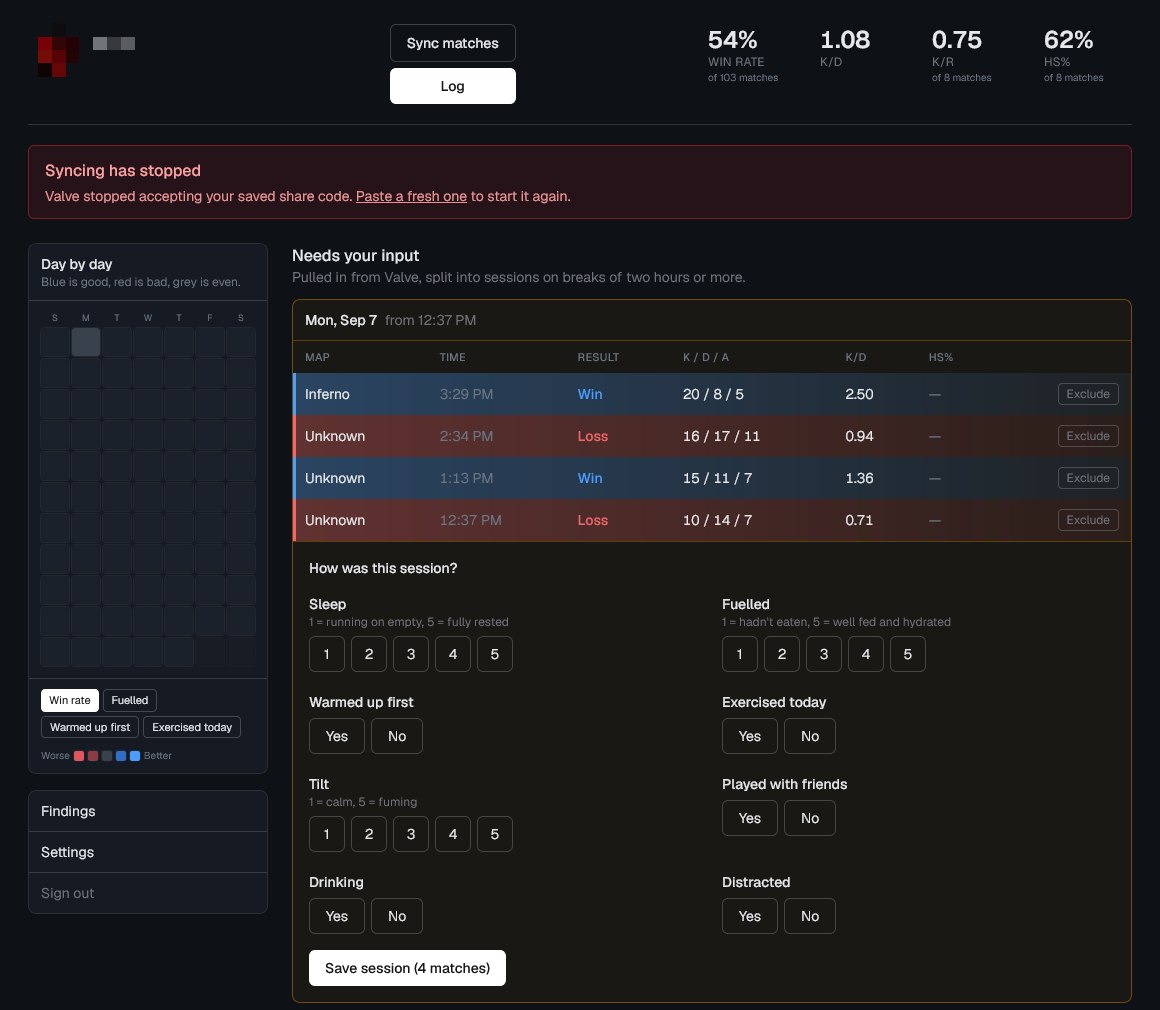
- 1Headline statsWin rate, K/D, K/R and headshot %
- 2Sync & LogPull new matches, or add one by hand
- 3Day by dayA calendar heatmap: blue is good, red is bad
- 4Needs your inputNew matches, grouped into a session, waiting for that session's habits
03 The Hypothesis
Do my habits change my results?
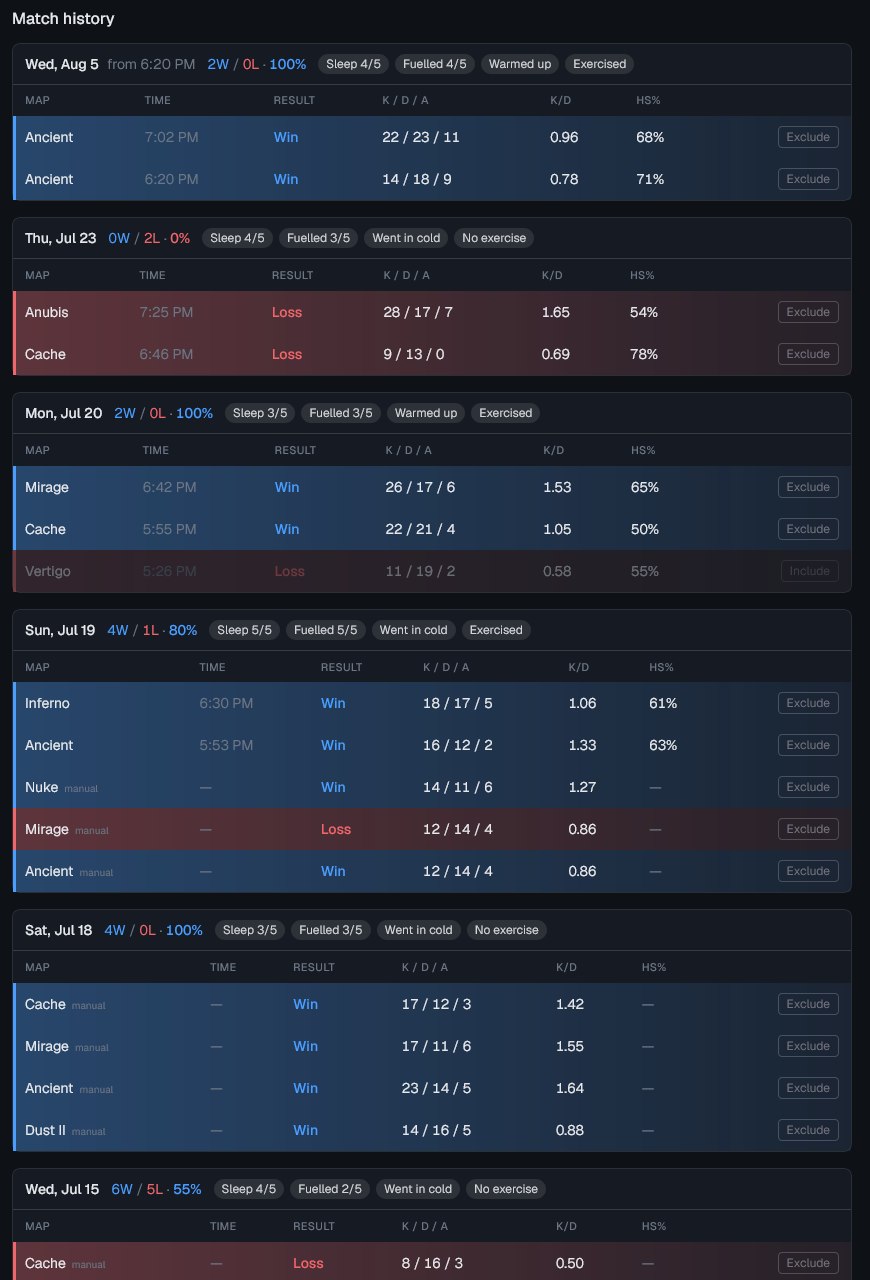
My original brief: a tool that logs the intangibles (sleep, nutrition, exercise, warm-up, tilt) alongside real match data, then shows how they line up. I set one rule early: automatic match pulling was a version-one priority, and typing matches in by hand was only a fallback.
04 How It Works
Five pieces, one button.
When you press Sync, the request travels through five pieces. The website host can't stay connected to Steam long enough to fetch a match, so a small sync worker on a separate service does that part, sleeps when idle, and costs very little. It logs in with a throwaway Steam account, so nobody's real password is stored anywhere. The same sync also runs every hour on its own.
- Your browserPresses Sync
- VercelHosts the website
- FlyRuns the sync worker
- ValveSupplies the match data
- SupabaseStores every match and answer
05 Building It
Testing it against my own matches changed the product more than the plan did.
5AI was tracking the wrong things.
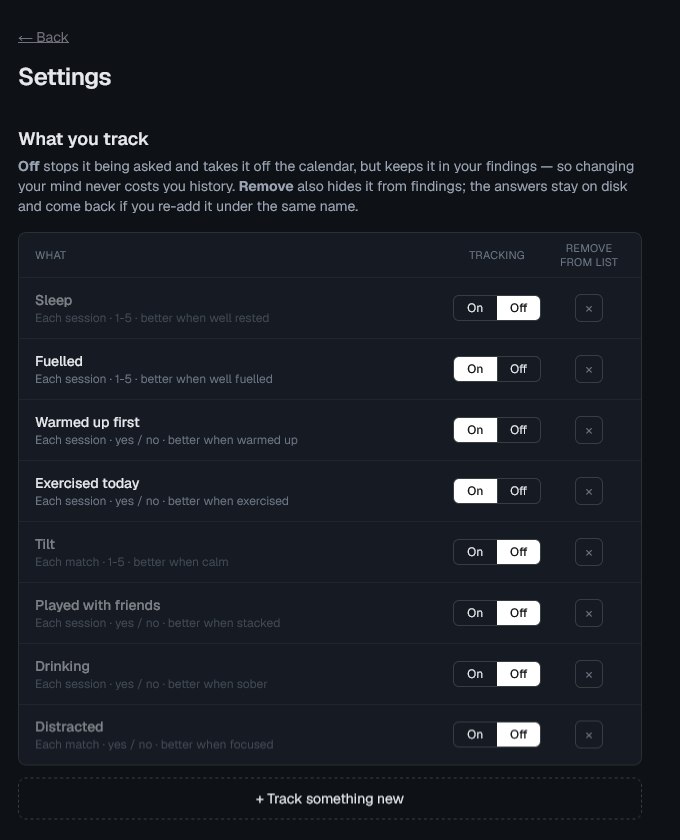
I sleep 7–8 hours almost every night and get over tilt quickly, so neither varied enough to explain anything. The fixed list of habits became trackers anyone can create, switch off, or remove, without losing their history.
5BOld matches without habits are worthless.
Research showed Valve stops sharing a match after about 30 days, and can only walk forward from a code you already have. It looked like a big limitation. I pointed out it barely mattered: nobody remembers how they slept two weeks ago, so old matches without the habits recorded alongside them would be useless anyway.
5CA session isn't a calendar day.
I had sessions split on a two-hour break instead of by date. Two hours is long enough for the things I was tracking to change, and it's a clean, simple cut-off.
5DA Sync button that only works on my PC isn't a feature.
The first version of syncing ran on my own computer. That wasn't good enough for a web app, which led to the separate sync worker that runs whether my PC is on or not.
5EChecked against what I'd logged by hand.
Valve doesn't send the map name; research found it hidden inside a number code, with no public table to decode it. We built one by comparing synced matches against the ones I'd typed in by hand: 6 for 6 on map, result, and kills/deaths/assists.
06 Key Decisions
6AUsable on day one, automatic on day three.
I had manual logging built before automatic syncing, the opposite of the plan's order. It made the app usable right away, and it gave me hand-logged matches to check the automation against later (5E).
6BWhere the sync lives.
Options were my own PC, or one of three hosting services. I picked Fly: it sleeps when idle so it costs very little, has no time limits, and works whether my PC is on or not. Syncing every hour instead of every 15 minutes was estimated at about two cents a month of difference; I chose hourly.
6CSome things a person should decide.
I only wanted Premier matches tracked, but Valve's data doesn't tell Premier and Competitive apart. A map filter would guess wrong, because I sometimes play Competitive on Premier maps, so I chose a manual "Exclude" button on each match.
07 Findings
If I can't read the chart, nobody can.
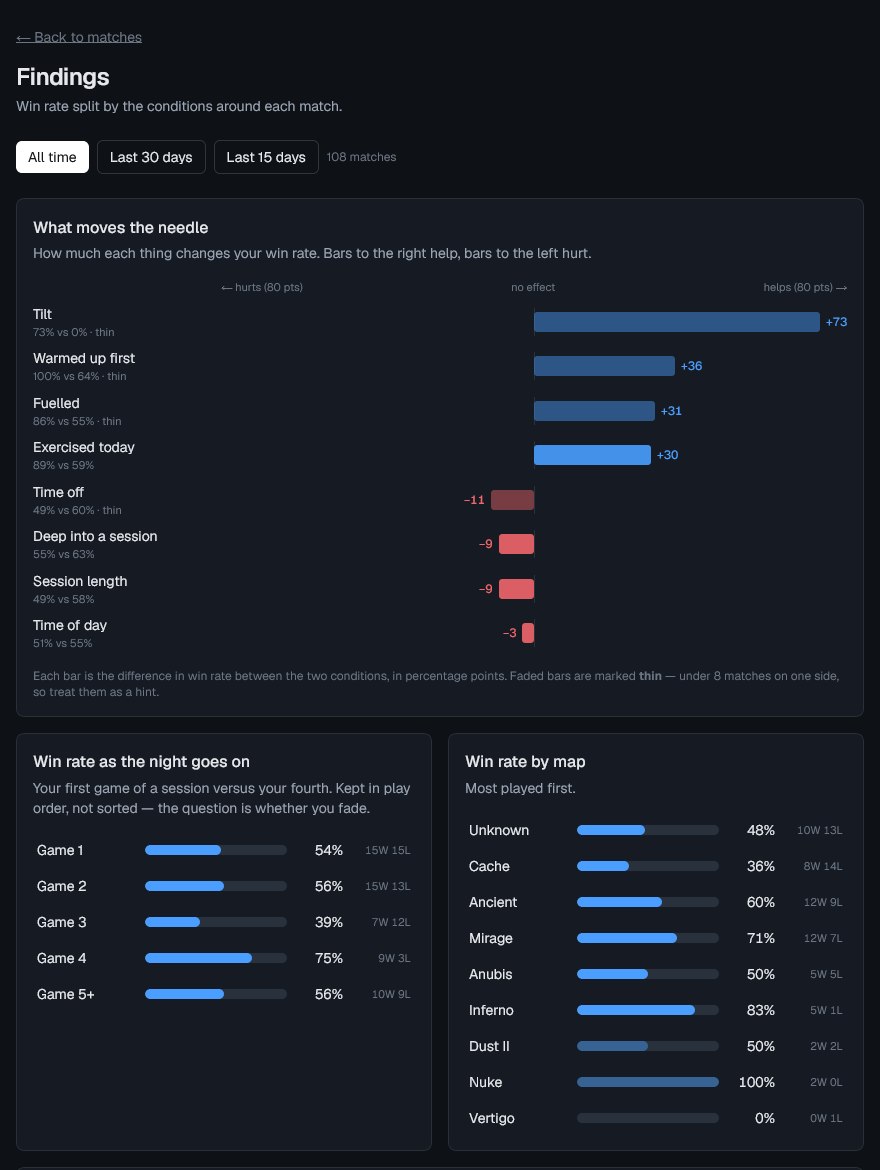
The first Findings chart was a "dumbbell" chart. My feedback: "if im struggling to instantly recognize the value in these charts i have a feeling others would too." It was replaced with bars that show the difference directly: right helps, left hurts. Anything based on fewer than 8 matches is marked "thin", so a hint never looks like a finding.
08 Retrospective
The robot kept working. I didn't.
After launch, automatic syncing pulled in 189 more matches. In the same period, I logged zero sessions. The automated half of the product kept running; the half that needed me, recording the habits, which was the whole point, stopped.
I knew going in that logging was the step with the most friction. I wanted to see how far I could take the idea anyway, and the answer was clear: automation carried everything except the part that mattered.
The honest reasons: logging after every session felt like a chore, and the questions started to feel like they had obvious answers. Of course I play better when I've eaten and slept well. And I was cooling on CS2 itself; when a game stops being fun, I drop it.
The core value can't depend on the most annoying step. I knew logging was the highest-effort part from the start. Building everything around it well didn't make it any less of a chore.
Answer a question that isn't obvious. If the user already believes the answer, the data isn't worth the effort of collecting it.
A tracker can't create commitment. It only works for someone already committed to recording the data.
Next: I'm not planning a version two. If I did, logging would be a three-tap check-in: three quick questions right after a session. The catch is that habits like sleep and food don't fit a simple yes/no, which is the harder problem.